Our Games
We provide effective and freely accessible games for higher education.
With their development, we are closing the gaps we identify in the educational games market.
Play them directly on this website and take a look at our teaching materials.
DIGITAL GAMES
TROJAN PLAYER TYPOLOGY
Research demonstrates that people enjoy games for diverse reasons. The Trojan Player Typology is an instrument developed by Kahn et al. (2015, https://doi.org/10.1016/j.chb.2015.03.018) to test 6 player motivations. For use in workshops, we have gamified the Trojan Player Typology. It takes roughly 15 minutes to play.
LEARNING OUTCOMES: At the end of the game, you will see your own motivational profile, and understand, how your play motivations can deviate from those of other people.
DEVELOPERS: Lucian Alikhani, Johannes Katsarov
PDFs of Additional Materials, Manual, Powerpoint etc…
uFood: The Social Media Marketing Game
 uFood: The Social Media Marketing Game is a serious game for students of marketing developed at Leuphana University Lueneburg as part of the DI-SZENARIO project.
LEARNING GOALS: Ethical sensitivity related to advertising with social media
CREATORS: Johannes Katsarov, Evgeniya Zakharova, Tammo Rabener, Tim Wagenbach, Yolanda Blanco Hoppmann, Lisa Tran, Paul Drews, Hannah Trittin-Ulbrich, Jascha Brandes, Ina Cramer, Nicolas Dierks, Markus Zimmer, Chiara Ludwig, Katharina Trostorff
PDFs of Additional Materials, Manual, Powerpoint etc…
Transform.Ed – School of the Future (Early Demo Version)
In Transform.Ed – School of the Future, the players take on the role of a school principal and have the task of building and leading a team to drive the school’s development forward. The players have to deal with the expectations of the school authorities and staff as well as students and parents and to improve their school in various areas.
The aim is to actively involve all stakeholders and win them over in favor of their own concerns. Throughout multiple chapters, the players deepen their knowledge in various fields of school improvement and change, acquiring skills in communication, trust, leadership and collaborative action within a school context.
Transform.Ed is developed as a single player game for PC, Tablet, Mobilephone or VR headsets accessible via browser. We aim to continually expand the scope of the game to effectively convey the skills and knowledge needed for sustainable school improvement and educational change. Transform.Ed is currently in a first test phase encompassing only the introductive tutorial.
LEARNING GOALS: Basics of change management, team leadership and effective school development
CREATORS: Ninja Müller, Dennis Wohlfeil, Johanna Willich, Saskia Sterzl, Johannes Katsarov, Marc Kleinknecht, Marcus Pietsch
PDFs of Additional Materials, Manual, Powerpoint etc…
CO-BOLD: A Serious Game on the Responsible Use of Artificial Intelligence in Business
In CO-BOLD, players check the quality of a new AI chatbot before it is delivered to a large customer. They learn to ask important questions, understand typical problems, and how to address them. Here, the game can only be played in English. We can also provide a German version though.
LEARNING GOALS: Sensitivity for ethical issues and risks of machine learning in novel business applications, speak-up competence.
CREATORS: Dr. Johannes Katsarov, Prof. Dr. Paul Drews, Prof. Dr. Hannah Trittin-Ulbrich
Soon to be published
PDFs of Additional Materials, Manual, Powerpoint etc…
CONSULTING STUDENTS
CONSULTING STUDENTS is a serious game for higher-education teachers which was developed in cooperation with Leuphana’s teaching service and an external advisory board.
LEARNING GOALS: Guiding the counselling process of a student. Setting framework conditions, time management, dealing competently with challenges.
CREATORS: Dustin Thulke, Timon Freyers, Dr. Johannes Katsarov, Marit Klinge, Saskia Sterzl, Johanna Willich
Anke Brehl, Judith Gurr, Sigrun Lehnert
ADVISORY BOARD: Claudia Nounla, Thies Reinecke, Nils Helge Schebb
Soon to be published
PDFs of Additional Materials, Manual, Powerpoint etc…
SUPERPARK - With AI and Automation Against Evil!
This unique serious game is set in an amusement park. But that’s not all — all the people here have superpowers! So do the players: With the help of ROBOTIC PROCESS AUTOMATION (RPA) and AI, the park’s processes are optimised, defended against the sinister plans of the villains and the SUPERPARK is saved from destruction. The focus is not only on technical progress, but also on responsibility in dealing with RPA technologies and employees.
The game conveys in an entertaining way how automation can be used responsibly, what opportunities it offers and what risks arise if technology is not used ethically. Designed in a colourful comic style, the game offers a combination of knowledge transfer and exciting entertainment about the modern world of automation now and in the future.
LEARNING GOALS:
- Understand the basic principles of different RPA variants
- Learn about the opportunities and risks of different RPA processes
- Responsible introduction and handling of employees during the introduction of automation technologies
CREATORS: Britta Werksnis, Oguzhan Demir, Prof. Dr. Paul Drews, Timon Freyer, Ivelina Karaatanasova, Dr. Johannes Katsarov, Tammo Rabener, Tim Wagenbach.
THEME PARK PARTNER: MagicPark Verden
Soon to be published
PDFs of Additional Materials, Manual, Powerpoint etc…
ANALOGUE GAMES
GAME MECHANICS FOR TRANSFORMATION
To be able to create their own educational games, students need to understand the impact of different game mechanics. Based on current research, we are developing an card game containing mechanisms that either promote or risk the development of moral sensibilities. With a thematic focus on sustainability.
The game is used in the seminar ‘Game-based Learning for Ethics and Sustainability’ at Leuphana University to support and reflect on students game development projects.
LEARNING GOALS: Serious Game Development, Game Mechanisms for Moral Sensibility and Sustainability.
CREATORS: Dr. Johannes Katsarov, Maya Kim, Prof. Dr. Torben Schmidt, Johanna Willich.
PDFs of Additional Materials, Manual, Powerpoint etc…

LEGO4SCRUM
Lego4Scrum © is an experiential workshop where participants build Lego models to learn and practice the Scrum framework. It’s designed to make abstract Scrum concepts tangible, demonstrating the flow of work, team dynamics, and the iterative nature of Agile development.
LEARNING GOALS:
- Provide participants with a deep understanding of Scrum roles, events, and artifacts.
- Enable participants to experience the entire Scrum process, from planning to reviewing.
- Demonstrate the importance of collaboration and communication in achieving a common goal.
- Prepare participants to apply Scrum practices in real-world projects.
CREATOR: Alexey Krivitsky (lego4scrum.com)
ADAPTED BY: Nilufar Ernazarova, Ivelina Karaatanasova, Dr. Johannes Katsarov, Saskia Sterzl
PDFs of Additional Materials, Manual, Powerpoint etc…
EXPLAIN IT LIKE AN ACROBAT
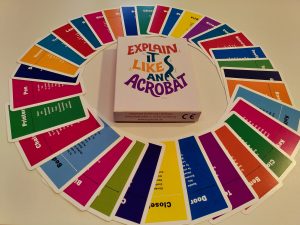
EXPLAIN IT LIKE AN ACROBAT is a taboo-inspired game with a little twist. Instead of the usual five, there are ten forbidden words in our game, which makes it a little more difficult to explain and guess the object terms. Therefore, the game presents the players with new linguistic challenges.
It is primarily intended to help not only find generic explanations, but also to think outside the box. It encourages people to break new ground and define everyday objects from a different perspective.
Explain It Like an Acrobat thus offers the opportunity to communicate with your team members on a perhaps different level, to become more creative in a playful way and at the same time to develop your own eloquence. In addition, it promotes shared experiences that are both fun and strengthens cooperation.
LEARNING GOALS: To strengthen players’ creative communication and conceptual explanation skills by challenging them to describe everyday objects without using the most obvious vocabulary — thereby promoting flexible thinking, linguistic creativity, better teamwork, and deeper reflection on how we construct and share meaning.
CREATORS: Game design — Marit Klinge, Steffi Hobuß, Johannes Katsarov, Michel Bieniek; Card design — Maya Kim, Lucian Alikhani
PDFs of Additional Materials, Manual, Powerpoint etc…
Feel free to share your questions thoughts feedback with us!
For a sneak peak please contact at saskia.sterzl@leuphana.de
We look forward to hearing from you! (:
We Respect Your Privacy
This site collects anonymous usage data to support research and improve our games.
By continuing, you agree to our Data Protection Policy.